The American Amphibious Drone Imperative: Closing the Hardware Gap in Disaster Response
OFFICIAL EXECUTIVE MEMORANDUM — Why the biggest gap in modern disaster response is no longer the forecast, but the hardware: a case for an American-built, amphibious, dual-sensor drone platform.
- Document
- Official Executive Memorandum
- Subject
- The American Amphibious Drone Imperative: Closing the Hardware Gap in Disaster Response
- From
- Office of the CEO
- Date
- July 29, 2026
- Target
- Federal, State & Industrial Partners
The forecast is no longer our biggest disaster-response gap. The hardware is. In the first hours after a flood or hurricane, situational awareness saves lives: where the water is going, which levee is failing, which roofs still have people. Today we answer those questions with drones — and too often, that drone is foreign-made, newly restricted, and built on a supply chain we do not control. That is a national vulnerability. What follows is the case, and a proposal.
01 The Stakes on American Soil
Recent events have made the cost of delayed situational awareness unambiguous. In every case, the bottleneck was the same: fast, accurate awareness over water and flooded terrain.
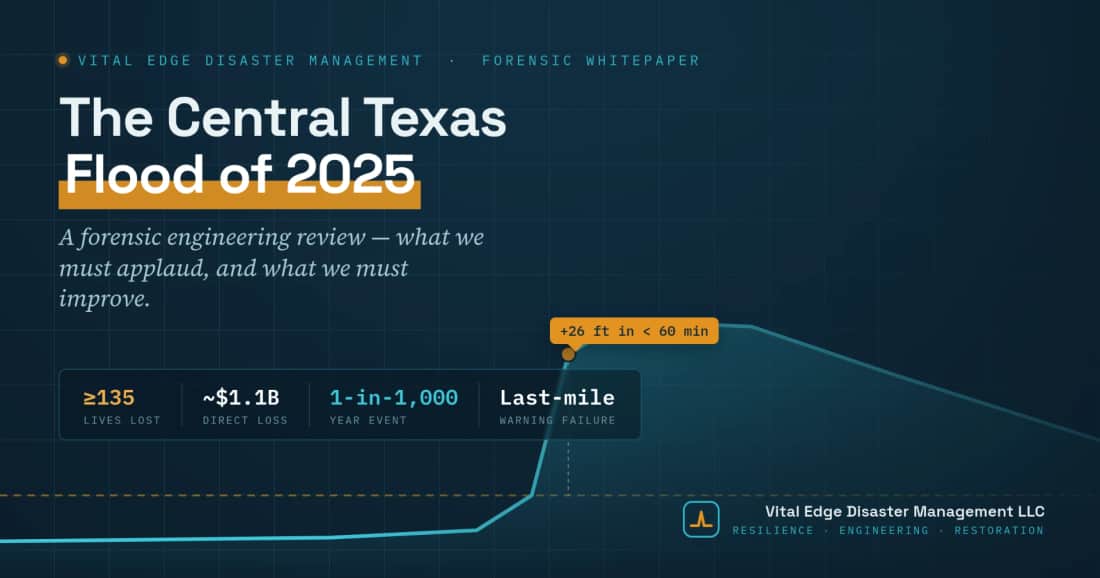
- Central Texas, 2025: The Guadalupe River rose approximately 26 feet in under an hour, leaving 135+ dead and roughly $1.1B in damage across the affected corridor.
- Hurricane Ian, Florida, 2022: 156+ dead and $112B in losses — the costliest storm in state history and a defining test of aerial response over flooded coastal terrain.
- The Common Failure Point: Responders could not see the disaster fast enough. Aerial awareness was fragmented, delayed, or dependent on platforms that could not launch from standing water.
02 The Dependency Just Became a Compliance Problem
What was once a procurement preference is now a federal restriction. Emergency managers, utilities, and critical-infrastructure operators funded by federal grants are directly exposed.
- American Security Drone Act (FY2024 NDAA): Federal funds may no longer be used to operate Chinese-made drones, reaching the police, fire, and emergency-management teams that run on federal grants.
- FCC Covered List, December 2025: Foreign-made drones and critical components — motors, GPS modules, cameras — were added to the Covered List, blocking new authorizations.
- Blue UAS Reality Check: The DoD's Blue UAS program is the trusted path, but domestic supply chains are years from volume and compliant options remain scarce and costly.
03 Even the Compliant Options Miss the Mission
Regulatory compliance is necessary but not sufficient. Disaster response has an operational profile that most authorized platforms were never engineered to serve.
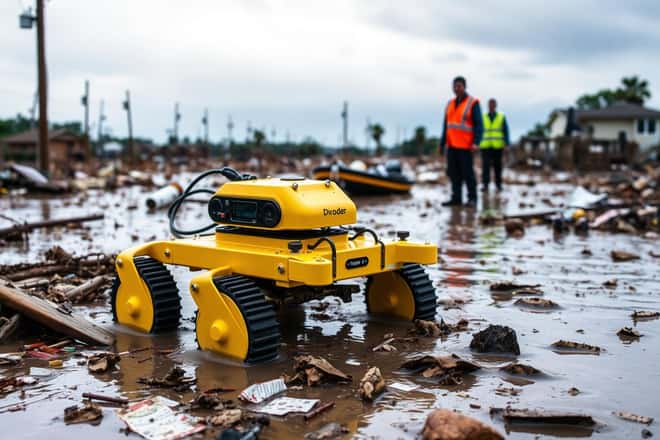
- Standing Water Launch: No dry ground, no runway, no stable pad — most authorized airframes cannot deploy from flooded terrain.
- Smoke and Darkness: Wildfire smoke, structural fires, and nighttime operations demand dual thermal and optical sensing as a baseline, not an upgrade.
- Overwater Search: Locating survivors on rooftops, in debris fields, or clinging to vehicles requires sustained flight over open water with sensors calibrated for human thermal signatures.
- Amphibious Endurance: Few platforms are truly amphibious, dual-sensor, and built for disaster workflows from the airframe up.
04 The Proposal: An American-Built Amphibious Disaster Drone
Vital Edge Disaster Management is advancing an American-designed, American-built amphibious drone platform purpose-built for the disaster response mission — engineered around the exact operational gaps identified above.
- Amphibious by Design: Operates over and on water, launching from flooded terrain, unstable ground, or the deck of a response vessel.
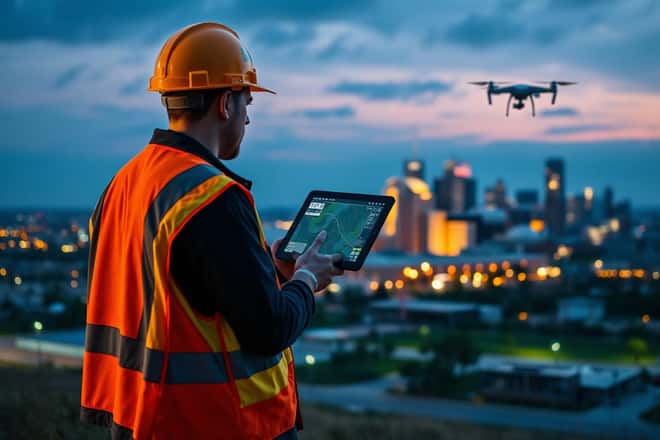
- Dual Vision Sensor Stack: Thermal and infrared imaging fused with high-resolution optical capture, engineered to find people through smoke and darkness and to document damage with forensic clarity.
- AI-Integrated Workflows: Automatic flood and terrain mapping, infrastructure inspection of levees, dams, and bridges, and rapid damage validation aligned to FEMA reporting standards.
- Compliance-Grade Supply Chain: Built to satisfy the American Security Drone Act and FCC Covered List requirements so any federally funded agency can legally deploy it on day one.
05 What This Looks Like in the Field
Picture this platform over Central Texas as the Guadalupe crested, or across Fort Myers Beach in the hours after Ian made landfall.
- Real-time flood maps streamed to incident commanders while the water is still rising.
- Thermal sweeps identifying survivors on rooftops, in attics, and across debris fields before daylight returns.
- Rapid structural assessments of levees, bridges, and critical facilities — from a secure, U.S.-controlled platform any federally funded agency can legally fly.
06 Why Domestic Manufacturing Matters
The case for building this platform in the United States is operational, not sentimental.
- Data Sovereignty: Sensitive imagery of critical infrastructure and disaster zones stays under U.S. jurisdiction and U.S. cybersecurity controls.
- Supply-Chain Resilience: Domestic production insulates disaster response from geopolitical shocks, export controls, and component blacklists.
- American Jobs: Engineering, manufacturing, and field-support roles anchored in U.S. communities.
- Faster Iteration: Direct feedback loops between American responders and American engineers shorten the development cycle from years to months.
- Trust: A platform built, audited, and serviced at home is a platform commanders can rely on when the water is rising.
07 A Question for the People Who Lead the Response
If you lead disaster response or critical-infrastructure protection, one question is worth carrying into your next planning cycle: what is the one capability your current aerial tools still cannot give you when the water is rising? Vital Edge Disaster Management was built to answer that question with American engineering, American manufacturing, and a platform designed for the disaster mission from the first bolt.