The Central Texas Flood of 2025: A Forensic Engineering Review
FORENSIC WHITEPAPER — The forecast didn't fail. The last mile did. A forensic look at the deadliest inland flash flood in the U.S. since 1976, and what consequence control demands next.
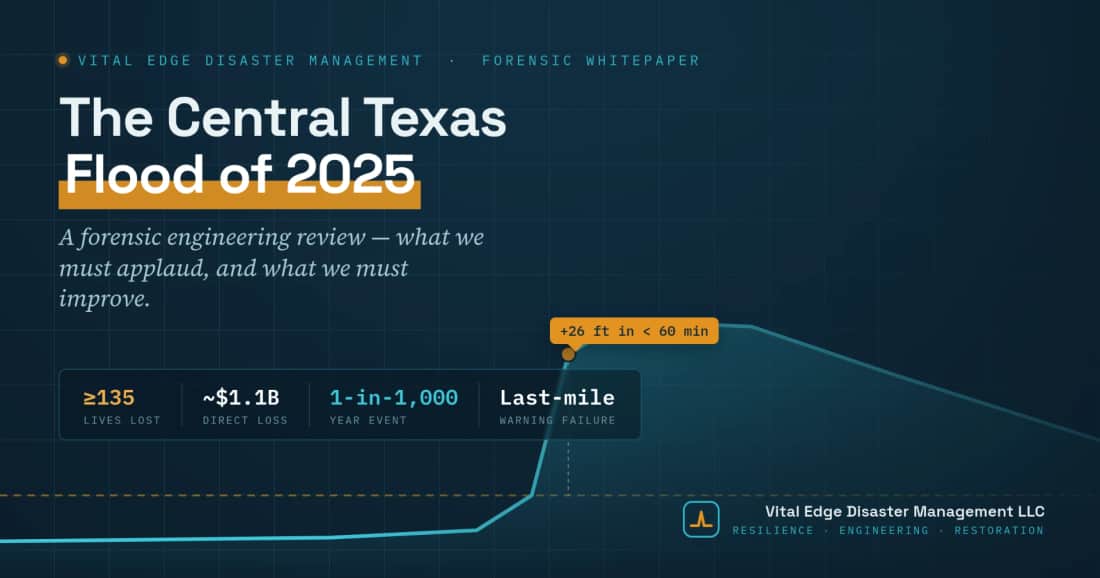
The forecast didn't fail. The last mile did. That's the hardest lesson from the July 2025 Central Texas flood — the deadliest inland flash flood in the U.S. since 1976.
Over July 4–7, the remnants of Tropical Storm Barry stalled over the Hill Country's “Flash Flood Alley.” The Guadalupe River rose about 26 feet in under an hour, in the pre-dawn dark of a holiday weekend, when riverside camps and cabins were full.
§ The toll
§ Here's the part that should change how we prepare
The National Weather Service did its job. An independent federal review found it was adequately staffed and its warnings were timely — a Flash Flood Warning at 1:14 a.m., then a rare Flash Flood Emergency.
The failure was the last mile. Kerr County never activated cell-phone emergency alerts in the critical hours. There were no sirens — a system debated for a decade and rejected around 2017 on cost. The river peaked while people slept.
§ We can't stop the rain. We can prevent most of the deaths.
Through consequence control:
- Automated alerts that trigger on measured water levels, not human decisions
- Sleeping-occupancy structures kept out of the floodway
- Pre-scripted “move to higher ground” triggers
- Closing the flood-insurance gap
What to applaud
Accurate forecasts, heroic swiftwater rescues, and fast reform — camp-safety laws and siren funding passed within two months. In 2026 flooding, new Kerr County sirens were credited with moving people to higher ground.
What to improve
Automate local alerts, get people out of the floodway, close the 88% insurance gap, and protect institutional memory so the siren debate never repeats.
When a river rises 26 feet in minutes, resilience is decided in the minutes between an accurate warning and a family reaching higher ground. We don't need better forecasts so much as better actuation.
If you manage flood risk for a community, campus, or facility: what's the biggest gap today between your warning system and real protective action?