A Corporate Contribution to Vital Edge Disaster Management Methodology
OFFICIAL EXECUTIVE MEMORANDUM — From the Office of the CEO to Global Stakeholders & Industrial Clients.
- Document
- Official Executive Memorandum
- Subject
- A Corporate Contribution to Vital Edge Disaster Management Methodology
- From
- Office of the CEO
- Date
- July 3, 2026
- Target
- Global Stakeholders & Industrial Clients
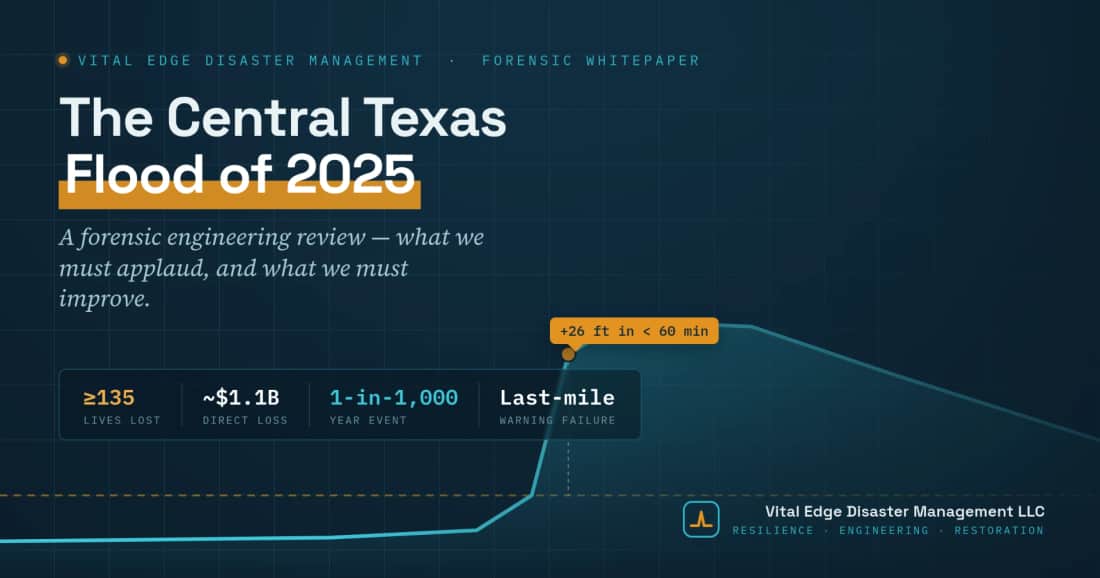
The paradigm of disaster management must evolve. Traditional consultative models that rely purely on reactive measures are fundamentally unequipped to handle the escalating volatility of our climate landscape — manifested in Category 5 hurricanes tearing through the Gulf Coast and the devastating 2025 flash floods in Central Texas. At Vital Edge Disaster Management, we are shifting the industry standard from manual planning to pure engineering, operational optimization, and indigenous deep tech. This framework details our proprietary methodologies designed to safeguard critical industrial assets, maintain community lifelines, and accelerate capital recovery under strict federal alignment.
01 Predictive Data Modeling & Dynamic Risk Evaluation
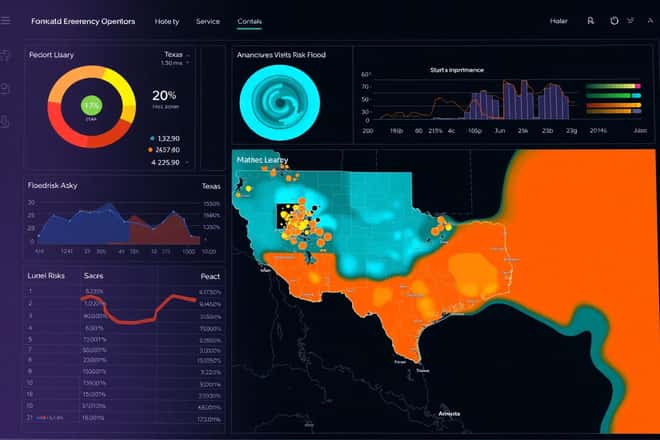
Passive data collection is an obsolete defense mechanism. Vital Edge replaces static mapping with a continuous, dynamic geospatial predictive modeling ecosystem. By integrating directly into existing Industrial Internet of Things (IIoT) frameworks and Geographic Information System (GIS) databases via secure APIs, we build a real-time, 3D virtual twin of the operational territory — mapping topography, hydrography, electrical grids, and critical transport arteries.
Leveraging Existing Infrastructure
Our methodology explicitly bypasses the costly and redundant installation of new physical sensors. By absorbing data directly from established enterprise networks, oil & gas infrastructure, and federal agencies (FEMA, NOAA), the marginal software cost of data ingestion approaches zero.
The core technological innovation lies in the automated processing of dense geospatial data. Traditionally, classifying and interpreting 3D point clouds from LiDAR scans required weeks of labor-intensive validation by geological engineers and surveyors. By deploying custom Computer Vision models, Vital Edge compresses this processing window from weeks to minutes, virtually eliminating analytical labor overhead and enabling near-instantaneous situational awareness.
Statistical optimization governs our defensive positioning. We calculate operational risk dynamically through a formalized mathematical function where risk R is derived from threat severity (A), asset vulnerability (V), and systemic response capacity (C):
02 Sovereign Field Operations: The VitalEdge Kraken-V
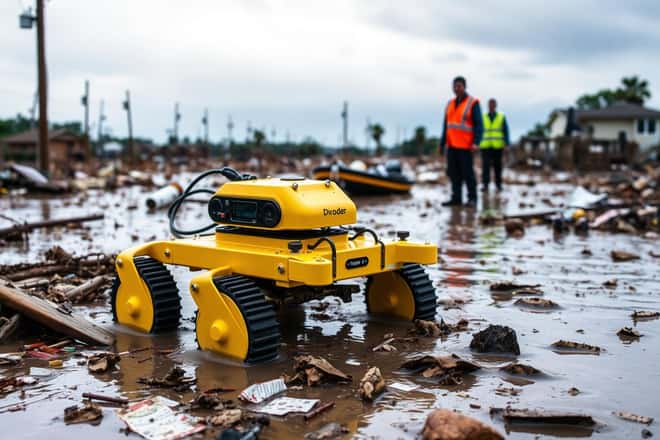
To mitigate reliance on fragile foreign supply chains and ensure operational resilience under national states of emergency, Vital Edge deploys proprietary, American-made autonomous robotic platforms. Our central tactical asset is the UAV Amphibious VitalEdge Kraken-V, designed and manufactured domestically to operate within severe atmospheric depressions, high-velocity currents, and extreme flooding conditions.
- Multi-Environment Operational Capacity: Engineered with advanced Vertical Takeoff and Landing (VTOL) mechanics, the Kraken-V executes stable flight and aquatic deployments, launching from structurally compromised land surfaces or turbulent, fast-moving flood waters.
- Long-Wave Infrared (LWIR) Thermographic Sensing: On-board computer vision edge-models penetrate dense layers of smoke, particulate haze, and thick canopy foliage to detect human thermal signatures, transmitting exact georeferenced coordinates with a latency of Δt < 2 seconds.
- Stereoscopic Structural Assessment: Integrated LiDAR payloads perform millimeter-level structural deformation scanning on critical infrastructure such as bridges, dikes, and crude oil storage tanks, preventing secondary catastrophic failures.
FEMA Infrastructure Classification Alignment
The Kraken-V segregates damage assessments based on the Federal Emergency Management Agency (FEMA) Community Lifelines framework, ensuring swift, prioritized deployment:
- 1. Critical Infrastructure (Lifelines): Essential services that, upon failure, pose an immediate threat to human life, safety, and national security, while obstructing government response. Vital Edge actively monitors and defends all 7 vital categories: Safety & Security; Food, Water, Shelter; Health & Medical; Energy; Communications; Transportation; and Hazardous Materials.
- 2. Non-Critical Infrastructure: Assets and commercial facilities that do not impact immediate human survival or frontline rescue capability (e.g., commercial retail centers, entertainment complexes). While necessary for long-term regional economic rehabilitation, their stabilization is sequenced after the critical lifelines are secured.
03 Strategic Planning & Industrial Logistics (FEMA-6 Optimization)
Operating under federal compliance guidelines, Vital Edge adopts the standard FEMA 6-Step Planning Process, but refactors it through automated industrial engineering and machine learning to achieve the velocity required by multinational industrial operations.
Phases 1 & 2 — Proactive Hardening and Incident Command System (ICS) Integration
We address the primary vulnerability of private sector emergency management: the lack of proactive preparation. Prevention is our primary pillar and a prerequisite for federal plan validation. Utilizing predictive AI, we simulate catastrophic events via Hazus-MH and geospatial twins, overlaying asset data onto official FEMA Flood Insurance Rate Maps (FIRM). This enables precise physical infrastructure hardening long before the onset of seasonal threats. When an alert is triggered, our systems establish direct data interoperability with regional Emergency Operations Centers (EOC) utilizing the standardized ICS matrix.
Phases 3 & 4 — Mathematical Optimization & Just-In-Time (JIT) Resource Deployment
Manual, static logistics planning is replaced with advanced mathematical programming to guarantee community lifelines and business continuity:
- Mixed-Integer Linear Programming (MILP): We execute MILP algorithms to solve resource allocation challenges. The objective function minimizes supply chain Lead Time by pre-positioning critical recovery assets in private, FEMA-validated Staging Areas while strictly respecting federally mandated mobility constraints and road closures.
- Queueing Theory for Contingency Routing: Evacuation and ingress corridors are modeled as stochastic waiting-line networks. This permits the structured, phased movement of critical plant personnel, avoiding localized traffic bottlenecks and streamlining regional Triage operations.
- Just-In-Time (JIT) Modular Configuration: Rather than over-saturating disaster zones — which incurs federal compliance penalties — our predictive engine configures automated logistical modules based on real-time field demand. Kraken-V assets are deployed during precise operational windows, delivering damage telemetry in standard formats required by FEMA audits to accelerate post-event insurance adjustments.
Phase 5 — Lean Six Sigma Governance & Federal Audit Readiness
Every operational metric, from optimized routing coordinates to thermal rescue vectors, is recorded and audited under the DMAIC framework. This provides a transparent, technically auditable operational ledger ensuring compliance with federal disaster assistance frameworks.
04 Industry 4.0 Technological Integration Matrix
Industry 4.0 solutions are never deployed in isolation; they are systematically bound to the disaster management lifecycle. The following matrix illustrates the architectural deployment of these technologies and their associated engineering impact metrics:
| Industry 4.0 technology | Specific emergency management application | Engineering efficiency metric |
|---|---|---|
| Artificial Intelligence & Edge Computing | On-board analytical processing of sensor arrays on autonomous amphibious UAVs, enabling local telemetry and inference without reliance on active satellite links. | 75% reduction in search, detection, and localization latency for isolated survivors. |
| Industrial Internet of Things (IIoT) | Resilient sensor mesh networks tracking water levels, hydro-dynamic pressure, and structural stress across critical basins and petrochemical networks. | Early warning generation with a predictive horizon of up to 6 hours prior to breach. |
| Large-Scale 3D Printing / Additive Manufacturing | In-situ additive manufacturing of custom structural bracing, compromised pipeline joints, and specialized tactical tools via mobile fabrication units. | 60% reduction in asset downtime during critical infrastructure rehabilitation phases. |
| Emergency Service Robotics (UGV) | Deployment of autonomous Unmanned Ground Vehicles for heavy debris clearance, high-risk interior structural scans, and Hazardous Materials (HazMat) mitigation. | Zero (0) first-responder or technical staff casualties during frontline intervention phases. |
05 Post-Incident Asset Stabilization & Environmental Control
The biological and structural decay window opens immediately following an event. Within 24 to 48 hours, standing water and atmospheric shifts introduce pathogenic risks and permanent asset degradation. Vital Edge triggers automated stabilization protocols to eliminate secondary corporate losses.
A. Ultra-Rapid Anti-Mold Protocol (24–48 Hour Critical Window)
To prevent the rapid germination of mold and fungal spores which destroy industrial interiors and mandate complete asset write-offs, we implement a scientific hygrometric stabilization procedure:
- Bulk Mechanical Water Extraction: High-capacity industrial submersible pumps and heavy-duty extractors remove standing water volume rapidly.
- Low Grain Refrigerant (LGR) Dehumidification: Commercial LGR units suppress ambient relative humidity below 50% to systematically disrupt the spore germination cycle.
- Dynamic Directional Structural Drying: Axial and centrifugal air movers are deployed based on meticulous Air Changes per Hour (ACH) calculations to extract deep-bound moisture from building substrates (gypsum, structural concrete, hardwoods) without causing physical warping.
- Biotic Enclosure Sanitization: Thermal fogging of hospital-grade, non-toxic botanical biocides neutralizes remaining airborne or surface bio-contaminants, ensuring long-term micro-biotic safety.
B. Fire & Fire-Product Restoration (Soot and Acidic Mitigation)
Soot compounds reacting with ambient moisture create highly corrosive acids that destroy advanced electronics and switchgear in hours. Affected surfaces are immediately washed and sealed with pH-neutralizing chemical agents. Concurrently, heavy HEPA-filtration air scrubbers integrated with hydroxyl generators neutralize volatile organic compounds (VOCs) and smoke odors at a molecular level, certifying the structure safe for immediate re-entry.
C. Xactimate & Forensic Insurance Synchronization
To minimize post-disaster friction and maximize corporate liquidity, all structural damage assessments, psychrometric drying logs, and operational expenses are directly compiled inside Xactimate, the global insurance industry standard. Vital Edge packages these data streams with comprehensive infrared thermographic telemetry, providing irrefutable forensic evidence that early-stage mitigation prevented catastrophic secondary losses, compelling insurers to execute rapid, preferential claims payouts.
06 Cellular Organizational Structure & Scalability
Vital Edge operates under a decentralized, high-agility structural model: Central Command with Replicable Tactical Cells. This architecture preserves the nimble execution of a specialized firm while providing the operational footprint of a multinational corporation.
Our expansion blueprint is phased to ensure continuous quality control:
- Phase 1 (Standardization): All proprietary technical workflows, hygrometric algorithms, and compliance frameworks are codified into an AI-driven digital operating manual.
- Phase 2 (Regional Replication): Expansion is achieved by duplicating the independent Tactical Response Cell — comprising one technical director, two certified field engineers, and a heavy deployment vehicle stocked with critical LGR dehumidifiers and LiDAR scanners — directly into new geographic territories, keeping overhead minimized.
- Phase 3 (Global Multinational Footprint): The corporate headquarters retains core software infrastructure, heavy drone fleets (Kraken-V), and global underwriting compliance, while localized tactical cells execute immediate operations worldwide, adhering seamlessly to distinct sovereign regulatory environments.
Elite Human Capital & Mobile Logistics Asset Inventory
Every operational leader and field technician holds master certifications recognized by the IICRC (Institute of Inspection Cleaning and Restoration Certification), including Water Damage Restoration Technician (WRT), Advanced Structural Drying Technician (ASD), and Mold Remediation Technician (AMRT), backed by mandatory OSHA 30 Industrial Safety compliance.
| Mobile equipment classification | Emergency mitigation function | Net engineering operational target capacity |
|---|---|---|
| LGR Dehumidifiers | Deep desiccant-based water extraction from porous structural materials and ambient air. | Removal of 150 to 200 pints of liquid volume per unit/day. |
| Axial Air Movers | High-velocity directional airflow to accelerate boundary-layer evaporation. | Targeted directional flow exceeding 3,000 CFM per unit. |
| HEPA Air Scrubbers | Negative-pressure micro-particulate filtration of fungal spores, carbon soot, and chemical airborne toxins. | 99.97% containment efficiency down to 0.3-micron particulate scale. |
| Mobile Power Generation | Uninterrupted multi-phase electrical supply for localized heavy machinery grids. | Towable diesel-generator configurations ranging from 50 kW to 150 kW. |
| FLIR Thermal Imaging Arrays | Non-invasive infrared moisture mapping and structural heat-signature diagnostics. | Sub-surface moisture boundary mapping without requiring structural breaching. |
07 Quality Control & Continuous Lean Six Sigma Governance
Every deployment is tracked via a closed-loop DMAIC (Define, Measure, Analyze, Improve, Control) pipeline. Real-time deviations in drying efficiency or logistical movement trigger automated root-cause analysis models, adjusting subsequent cell routing instantly.
Upon operational closure, the system generates the comprehensive VitalEdge Engineering Technical Report. This auditable document serves as the master record for corporate boards, environmental agencies, and federal compliance monitors, confirming with scientific certainty that the asset has safely returned to its nominal operational baseline.